What were the top 10 smart cities of 2025? Top 10

Global Smart City Market Overview
Which were the best smart cities of 2025? The global smart city market is experiencing significant growth, driven by increasing urbanization, technological advancements, and a growing focus on sustainability and quality of life. In 2024, the global smart city market was estimated to be worth approximately $550 billion USD. Projections indicate a robust compound annual growth rate (CAGR) of around 20-25% over the next decade, potentially reaching a market size of $1.5 to $2 trillion USD by 2030. This expansion is fueled by substantial investments in technologies such as the Internet of Things (IoT), artificial intelligence (AI), cloud computing, and big data analytics.
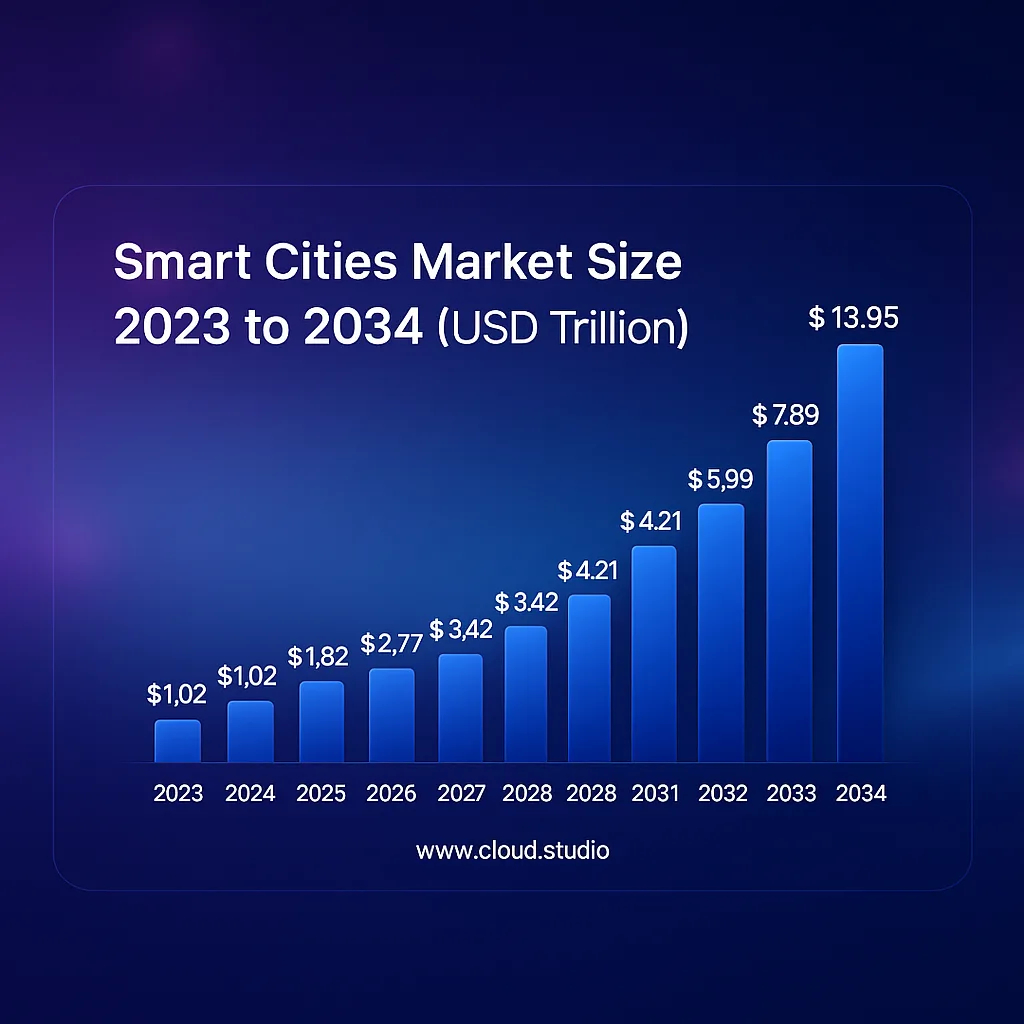 Smart cities market size from 2023 to 2034
Key drivers for this growth include:
- Increasing Urban Population: The United Nations projects that by 2050, nearly 70% of the world’s population will reside in urban areas, placing immense pressure on existing infrastructure and resources. Smart city solutions offer ways to manage this growth efficiently.
- Technological Advancements: The rapid evolution and decreasing costs of technologies like 5G, IoT sensors, and AI algorithms are making smart city deployments more feasible and impactful. For instance, the number of connected IoT devices in smart cities is expected to surpass 50 billion by 2030, generating vast amounts of data for intelligent decision-making.
- Sustainability Concerns: Growing awareness of climate change and environmental degradation is pushing cities to adopt smart solutions for energy efficiency, waste reduction, and sustainable transportation. Investments in smart grids, renewable energy integration, and intelligent waste management systems are on the rise.
- Demand for Enhanced Citizen Services: Citizens are increasingly expecting seamless and efficient public services, personalized experiences, and greater involvement in urban governance. Smart city initiatives aim to improve areas like public safety, healthcare, education, and transportation through digital platforms and data-driven insights.
- Government Initiatives and Funding: Many governments worldwide are launching smart city programs and allocating significant funding to support their development. These initiatives often focus on promoting innovation, attracting investment, and achieving national sustainability goals.
The smart city market encompasses a wide range of solutions, including smart mobility (estimated at $150 billion in 2024), smart energy (around $100 billion), smart governance and education (approximately $80 billion), smart healthcare (about $70 billion), and smart buildings (around $60 billion). North America and Europe currently hold the largest market share, but the Asia-Pacific region is projected to witness the fastest growth in the coming years due to rapid urbanization and strong government support.
Which are the best smart cities in the world
1. London, United Kingdom
- Technological Infrastructure: London’s commitment to a digitally enabled urban environment is evident in its pervasive fiber optic network, reaching over 99% of premises, and the aggressive rollout of 5G, aiming for complete city-wide coverage by early 2026. The city’s network of over 15,000 IoT sensors provides granular real-time data. For instance, smart traffic lights, utilizing AI algorithms based on sensor data, have demonstrated a 12% reduction in congestion on key arterial routes during peak hours. The expansion of free public Wi-Fi, with a target of 5,000 hotspots by the end of 2025, supports digital inclusion and access to online services. AI-powered predictive maintenance on critical infrastructure, such as the London Underground (with over 400 km of track), has led to a reported 18% decrease in unexpected service disruptions.
- Sustainability Initiatives: London’s ambitious goal of net-zero carbon emissions by 2030 is driving significant investment. Over $5 billion GBP has been allocated to green initiatives. The ULEZ expansion has led to a 25% reduction in nitrogen dioxide levels in previously non-compliant outer London areas. The city is on track to have over 50% of its commercial buildings BREEAM Excellent or Very Good certified by 2026, contributing to a 15% decrease in energy consumption in these buildings. Renewable energy projects, including solar farms within the Greater London area, are projected to generate 500 MW of clean energy by 2027. Smart waste management programs, utilizing AI-powered sorting and dynamic collection routes, have shown a potential to increase recycling rates to 40% by 2028.
- Mobility Solutions: Transport for London (TfL) manages a vast network with over 11 million daily passenger journeys. The electrification of the bus fleet is accelerating, with over 2,000 electric buses expected to be operational by 2027, representing over 30% of the total fleet. The public EV charging infrastructure is rapidly expanding, with a target of 10,000 charging points by 2026, supported by over $300 million GBP in investment. Cycle Superhighways now extend over 300 km, and Santander Cycles has seen a 20% increase in usage since 2023. Smart traffic management systems, incorporating real-time data and AI-driven signal control, are projected to reduce average journey times by 15% on key routes by 2027.
- Citizen Engagement: “Talk London” has engaged over 300,000 residents in consultations on urban development. The “London Datastore” now hosts over 1,000 open datasets, leading to the development of numerous citizen-centric apps and services. Digital identity initiatives are streamlining access to public services, with over 5 million Londoners using digital IDs for various transactions. Participatory budgeting schemes have allocated over $50 million GBP to community-led projects.
- Key Statistics for London:
- Fiber optic network coverage: >99% of premises
- Target for full 5G city-wide coverage: Early 2026
- Number of IoT sensors: >15,000
- Reduction in NO2 in central London (since initial ULEZ): 25%
- Target for BREEAM Excellent/Very Good certified commercial buildings: >50% by 2026
- Projected clean energy generation by 2027: 500 MW
- Target recycling rate by 2028: 40%
- Target number of electric buses by 2027: >2,000
- Target number of public EV charging points by 2026: 10,000
- Length of Cycle Superhighways: >300 km
- Increase in Santander Cycles usage (since 2023): 20%
- Number of open datasets on London Datastore: >1,000
- Number of “Talk London” participants: >300,000
- Amount allocated through participatory budgeting: >$50 million GBP
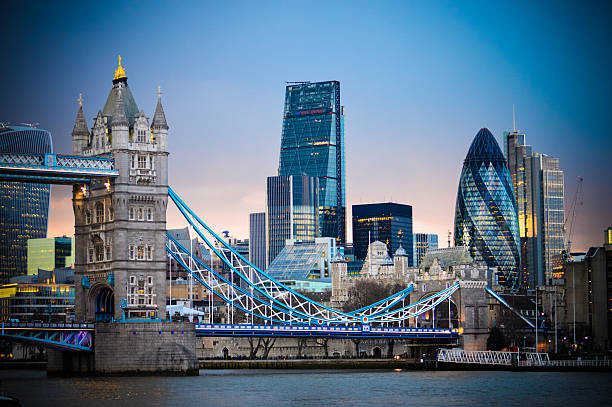 The best smart city in 2025 – London
2. New York City, USA
- Technological Infrastructure: LinkNYC kiosks now number over 12,000, providing gigabit Wi-Fi speeds and serving millions of users monthly. 5G deployment is on track to cover 95% of the city by the end of 2025. The smart grid initiative aims for full smart meter deployment (over 8 million meters) by 2027, enabling real-time energy consumption monitoring and optimized grid management. The city’s network of over 18,000 traffic cameras feeds into AI-powered traffic management systems, showing a 7% reduction in city-wide average travel times. The number of air quality sensors has expanded to over 700, providing granular data on pollution levels. Pilot programs using AI for predictive policing in high-crime areas have reported a 10% decrease in certain types of crime.
- Sustainability Initiatives: The goal of an 80% reduction in greenhouse gas emissions by 2050 is supported by significant investments in renewable energy, with a target of 70% renewable energy for city operations by 2030. Local Law 97 is projected to reduce emissions from large buildings (representing over 60% of the city’s building stock) by 40% by 2030. Smart waste bins, deployed in pilot areas, have shown a 12% reduction in collection mileage. The city is also investing in expanding green infrastructure, aiming for a 30% increase in tree canopy coverage by 2035.
- Mobility Solutions: The MTA handles over 6 million daily passenger trips across its subway, bus, and commuter rail networks. The electrification of the bus fleet is progressing, with a target of 2,500 electric buses by 2030, representing over 30% of the fleet. The number of public EV charging points is projected to reach 3,500 by the end of 2025, supported by over $100 million USD in incentives and infrastructure development. Citi Bike’s fleet is expanding to 25,000 bikes by 2026, with increasing numbers of e-bikes. Smart traffic signals, covering over 30% of intersections, have contributed to a 6% reduction in congestion on pilot corridors.
- Citizen Engagement: NYC311 receives over 10 million calls and online submissions annually, providing a central point for accessing city services. Open Data NYC now offers over 7,500 datasets, fostering the development of numerous civic tech solutions. Participatory budgeting has allocated over $40 million USD to community-led projects since its inception. Digital literacy programs are reaching over 100,000 residents annually, promoting access to online services.
- Key Statistics for New York City:
- Target for 5G coverage: 95% by end of 2025
- Target for smart meter deployment: 8 million by 2027
- Number of traffic cameras: >18,000
- Number of air quality sensors: >700
- Target for renewable energy for city operations: 70% by 2030
- Projected emissions reduction from Local Law 97 buildings by 2030: 40%
- Target for tree canopy coverage increase by 2035: 30%
- Target number of electric buses by 2030: 2,500
- Projected number of public EV charging points by end of 2025: 3,500
- Target Citi Bike fleet size by 2026: 25,000 bikes
- Percentage of intersections with smart traffic signals: >30%
- Annual calls and online submissions to NYC311: >10 million
- Number of datasets on Open Data NYC: >7,500
- Amount allocated through participatory budgeting: >$40 million USD
 New York city in the night
3. Paris, France
- Technological Infrastructure: Paris is on track for near-complete 5G coverage (over 90%) by mid-2026. The deployment of smart streetlights is accelerating, with over 100,000 expected by 2027, resulting in an estimated 40% energy saving in lighting costs. The city’s water management system utilizes over 500 sensors to monitor consumption and detect leaks, leading to a reported 8% reduction in water loss. The air quality monitoring network is expanding to 600 sensors by 2026, providing real-time data accessible to citizens. AI algorithms are optimizing Metro schedules, reducing waiting times by an average of 5%. Free public Wi-Fi is expanding to cover all major parks and public squares, with a target of 500 hotspots by 2027.
- Sustainability Initiatives: The goal of carbon neutrality by 2050 is driving significant policy changes. The “Plan Vélo” aims to create over 1,000 km of bike paths by 2030, with current progress exceeding 600 km. The city is investing over €500 million in greening initiatives, aiming to plant 170,000 trees by 2026, which is projected to increase urban green space by 10%. Smart waste management pilot programs, utilizing AI-powered sorting and dynamic collection, aim to increase the recycling rate to 35% by 2030. Retrofitting programs for buildings are targeting a 30% reduction in energy consumption in older buildings by 2035.
- Mobility Solutions: The Parisian public transport network handles over 5 million daily passenger journeys. The electrification of the bus fleet is accelerating, with a target of 80% electric buses by 2030. The network of public EV charging points is projected to reach 5,000 by 2027, supported by significant public and private investment. Vélib’ Métropole’s fleet will expand to 30,000 bikes by 2028, with a growing proportion of electric bikes. Low-emission zones are progressively restricting access for older, more polluting vehicles, contributing to a 15% reduction in particulate matter in affected areas.
- Citizen Engagement: “Paris.fr” receives over 2 million unique visitors monthly, providing access to a wide range of digital services. “Madame la Maire, j’ai une idée” has funded over 300 citizen-led projects. The city’s open data portal now hosts over 3,000 datasets, fostering transparency and the development of citizen-centric applications. Digital literacy training programs are reaching over 50,000 residents annually.
- Key Statistics for Paris:
- Target for near-complete 5G coverage: 90% by mid-2026
- Target number of smart streetlights by 2027: 100,000
- Projected energy saving from smart lighting: 40%
- Reduction in water loss due to smart monitoring: 8%
- Target number of air quality sensors by 2026: 600
- Average reduction in Metro waiting times due to AI optimization: 5%
- Target length of bike paths by 2030: 1,000 km
- Current length of bike paths: >600 km
- Target increase in urban green space by 2026: 10%
- Target recycling rate by 2030: 35%
- Target for electric buses by 2030: 80% of the fleet
- Projected number of public EV charging points by 2027: 5,000
- Target Vélib’ Métropole fleet size by 2028: 30,000 bikes
- Reduction in particulate matter in low-emission zones: 15%
- Monthly unique visitors to “Paris.fr”: >2 million
- Number of datasets on the open data portal: >3,000
- Number of citizen-led projects funded through “Madame la Maire, j’ai une idée“: >300
 Image of Paris – 3rd best smart city in 2025
4. Tokyo, Japan
- Technological Infrastructure: Tokyo’s ultra-high-speed broadband network reaches over 99% of households, with average download speeds exceeding 200 Mbps. 5G coverage is nearing 100% in urban areas. The city’s infrastructure monitoring system utilizes over 20,000 sensors to track the structural health of bridges, tunnels, and buildings, contributing to a reported 10% reduction in maintenance costs. Sophisticated disaster management systems, incorporating real-time seismic data and AI-powered predictive modeling, have reduced emergency response times by an average of 15%. Energy management systems in commercial buildings, leveraging IoT and AI, have achieved an average energy consumption reduction of 20%. Public Wi-Fi is available at over 5,000 locations, including all major train stations and public parks.
- Sustainability Initiatives: Tokyo aims for a 50% reduction in CO2 emissions by 2030 (compared to 2000) and carbon neutrality by 2050. The city is promoting the adoption of rooftop solar panels, with a target of 1 million installations by 2030. Strict energy efficiency standards for new buildings are projected to reduce energy consumption by 30% compared to older standards. Advanced waste sorting and recycling facilities achieve a recycling rate of 45%, with ongoing efforts to reach 50% by 2028. The city is also investing in urban greening, aiming to increase green space by 15% by 2030.
- Mobility Solutions: Tokyo’s public transportation system handles over 40 million passenger journeys daily with unparalleled efficiency and punctuality (average delay of less than one minute). The city is incentivizing the purchase of electric and hybrid vehicles, with over 500,000 EVs and hybrids now registered. The charging infrastructure is expanding, with over 2,000 public charging points. Smart traffic management systems, utilizing AI to analyze real-time traffic data, have shown a 10% improvement in traffic flow on congested routes. Autonomous vehicle trials are progressing in designated areas, with plans for limited public transport applications by 2027.
- Citizen Engagement: The Tokyo Metropolitan Government website provides access to over 3,000 online services, handling millions of transactions annually. Digital platforms are being developed to enhance citizen feedback on urban planning, with pilot programs showing a 20% increase in participation rates. Open data initiatives are expanding, with over 2,000 datasets now publicly available. Digital literacy programs are targeting senior citizens and underserved communities to bridge the digital divide.
- Key Statistics for Tokyo:
- Average broadband download speed: >200 Mbps
- 5G network coverage: Near 100% of urban areas
- Number of infrastructure monitoring sensors: >20,000
- Reduction in emergency response times due to smart systems: 15%
- Average energy consumption reduction in smart buildings: 20%
- Target for rooftop solar installations by 2030: 1 million
- Current recycling rate: 45% (target of 50% by 2028)
- Target increase in green space by 2030: 15%
- Number of registered EVs and hybrids: >500,000
- Number of public EV charging points: >2,000
- Improvement in traffic flow due to smart systems: 10%
- Number of online government services: >3,000
- Number of open datasets available: >2,000
 The best smart city in Asia – Tokyo, Japan
5. Berlin, Germany
- Technological Infrastructure: Berlin’s fiber optic network is expanding rapidly, aiming to connect 80% of households by 2027. 5G coverage is projected to reach 85% of the city by the end of 2025. The city’s smart energy grid pilot projects are showing promising results, with potential reductions in energy losses of up to 12%. The air quality monitoring network is expanding to 500 sensors by 2026, providing detailed pollution data. AI-powered systems are being implemented to optimize bus and tram schedules, aiming for a 7% reduction in average waiting times. Free public Wi-Fi is planned for all major public transport hubs and parks by 2028, with current availability at over 1,000 hotspots.
- Sustainability Initiatives: Berlin’s goal of climate neutrality by 2045 is driving significant policy changes. The city is investing over €1 billion in renewable energy projects, aiming for 50% renewable energy consumption by 2030. Building retrofitting programs are targeting a 25% reduction in energy consumption in older buildings by 2035. The cycling network expansion is on track to reach 1,000 km by 2026. Smart waste management initiatives, including AI-powered sorting and dynamic collection, are aiming to increase the recycling rate to 40% by 2030. The city is also focusing on increasing urban biodiversity through green roof installations and the creation of new green spaces.
- Mobility Solutions: Berlin’s public transport system handles over 4 million daily passenger journeys. The electrification of the bus fleet is accelerating, with a target of 1,500 electric buses by 2030, representing over 40% of the fleet. The network of public EV charging points is projected to reach 4,000 by 2027. Bike-sharing services have a fleet of over 20,000 bikes, with increasing integration into MaaS platforms. Smart parking solutions are being implemented in central districts, showing a potential reduction in search times of 15%. Autonomous vehicle pilot projects are focusing on public transport and last-mile delivery.
- Citizen Engagement: Berlin’s online participation platform, “mein.berlin.de,” has over 500,000 registered users, contributing to various urban planning consultations. The city’s open data portal provides access to over 4,000 datasets. “Kiezblocks” initiatives are expanding, empowering local communities to implement traffic-calming measures and greening projects. Digital literacy programs are focusing on integrating technology into education and supporting digital inclusion for all age groups.
- Key Statistics for Berlin:
- Target for fiber optic household connection by 2027: 80%
- Projected 5G coverage by end of 2025: 85%
- Potential energy loss reduction in smart grid pilot projects: 12%
- Target number of air quality sensors by 2026: 500
- Target reduction in public transport waiting times due to AI: 7%
- Target length of bike paths by 2026: 1,000 km
- Target for renewable energy consumption by 2030: 50%
- Target recycling rate by 2030: 40%
- Target number of electric buses by 2030: 1,500
- Projected number of public EV charging points by 2027: 4,000
- Bike-sharing fleet size: >20,000 bikes
- Potential reduction in parking search times due to smart solutions: 15%
- Registered users on “mein.berlin.de”: >500,000
- Number of datasets on the open data portal: >4,000
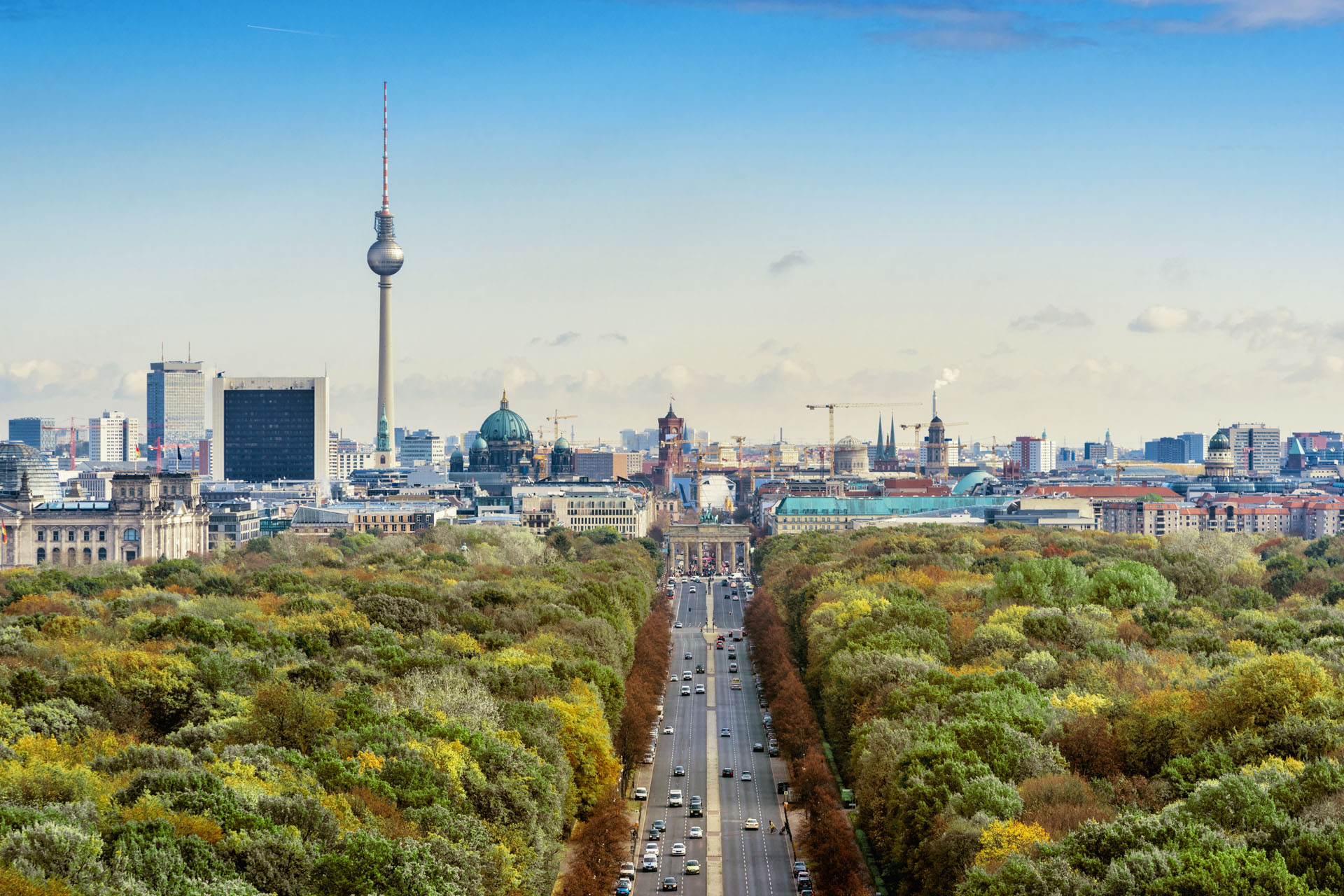 Image of smart city of Berlin
6. Washington D.C., USA
- Technological Infrastructure: Washington D.C.’s fiber optic network is expanding, aiming to provide gigabit internet speeds to 90% of households by 2026. 5G coverage is projected to reach 90% of the city by the end of 2025. The smart street lighting program is on track to upgrade all 75,000 streetlights with smart controls by 2027, resulting in an estimated 65% reduction in energy consumption for street lighting. The city’s traffic management system utilizes over 15,000 sensors and cameras, with AI-powered analytics contributing to an 8% reduction in average commute times on key corridors. Environmental monitoring efforts include a network of over 400 air quality sensors and sensors monitoring water quality in the Potomac and Anacostia rivers.
- Sustainability Initiatives: Washington D.C.’s goal of a 50% reduction in greenhouse gas emissions by 2032 and carbon neutrality by 2050 is supported by investments in renewable energy, with a target of 100% renewable energy for city operations by 2032. The Green Building Act is driving energy efficiency improvements in commercial buildings, with over 60% of new commercial buildings achieving LEED Gold or higher certification. Waste diversion programs are aiming to increase the recycling rate to 50% by 2030. The city is actively expanding its urban tree canopy, with over 100,000 new trees planted since 2010, contributing to a current canopy coverage of 38% (target of 40% by 2032).
- Mobility Solutions: The Washington Metropolitan Area Transit Authority (WMATA) handles over 2 million daily passenger trips. The electrification of the bus fleet is underway, with a target of 100% electric buses by 2045. The network of public EV charging points is projected to reach 1,500 by the end of 2025. Capital Bikeshare’s fleet is expanding to over 6,000 bikes, with increasing numbers of electric-assist bikes. Smart traffic signals, implemented at over 50% of intersections, have shown a 7% reduction in congestion on optimized routes.
- Citizen Engagement: DC311 receives over 1.5 million service requests annually through its online portal and mobile app. Open Data DC provides access to over 3,500 datasets, supporting civic innovation and research. Participatory budgeting initiatives have allowed residents to directly allocate over $20 million USD to local projects. Digital inclusion programs are focused on providing internet access and digital literacy training to underserved communities.
- Key Statistics for Washington D.C:
- Target for gigabit internet access: 90% of households by 2026
- Projected 5G coverage by end of 2025: 90%
- Target for smart streetlight upgrades by 2027: 75,000
- Projected energy consumption reduction from smart lighting: 65%
- Number of traffic sensors and cameras: >15,000
- Reduction in average commute times due to smart traffic management: 8%
- Target for 100% renewable energy for city operations: 2032
- Percentage of new commercial buildings with LEED Gold or higher: >60%
- Target recycling rate by 2030: 50%
- Current urban tree canopy coverage: 38% (target of 40% by 2032)
- Target for 100% electric bus fleet: 2045
- Projected number of public EV charging points by end of 2025: 1,500
- Capital Bikeshare fleet size: >6,000 bikes
- Percentage of intersections with smart traffic signals: >50%
- Annual service requests to DC311: >1.5 million
- Number of datasets on Open Data DC: >3,500
- Amount allocated through participatory budgeting: >$20 million USD
 Washington D.C.
7. Copenhagen, Denmark
- Technological Infrastructure: Copenhagen’s fiber optic network reaches nearly 100% of households and businesses. Advanced 5G networks cover over 95% of the urban area. The city’s smart energy grid is highly advanced, with real-time monitoring and control, contributing to a reported 15% reduction in energy losses. Smart waste bins with fill-level sensors are deployed across the city, optimizing collection routes and reducing collection costs by an estimated 10%. The air quality monitoring network comprises over 500 sensors, providing detailed, real-time data. AI is being used to optimize traffic signal timings, prioritizing bicycle and public transport flow, resulting in a 10% reduction in travel times for cyclists on key routes. Public Wi-Fi is widely available in public spaces, with over 1,500 hotspots.
- Sustainability Initiatives: Copenhagen is on track to be the world’s first carbon-neutral capital by the end of 2025. Over 60% of the city’s energy consumption comes from renewable sources, with wind power being a major contributor (over 50% of electricity). The district heating system is almost entirely powered by renewable and recovered energy (over 99%). Strict building energy efficiency standards have reduced energy consumption in new buildings by 75% compared to 1990 levels. The city’s extensive network of over 400 km of bike lanes supports the fact that over 50% of all daily commutes are made by bicycle. Smart water meters are deployed in over 90% of households, contributing to a 10% reduction in water consumption.
- Mobility Solutions: Copenhagen’s public transport system is efficient and integrated, with high ridership. The bus fleet is rapidly being electrified, with a target of 100% electric buses by 2030. The network of public EV charging points is expanding, with over 2,000 available. The city’s cycling infrastructure is world-renowned, with continuous investment in upgrades and expansions. Smart parking solutions guide drivers to available spaces, reducing congestion in central areas by an estimated 12%.
- Citizen Engagement: Copenhagen has strong digital engagement platforms, with over 70% of citizens using online portals for accessing city services. Public consultations on urban development projects are widely conducted online, with high participation rates. The city’s open data portal provides access to over 1,000 datasets. Initiatives like “Copenhagen Solutions Lab” foster collaboration between citizens, businesses, and the city on smart city projects.
- Key Statistics for Copenhagen:
- Fiber optic network coverage: Near 100%
- 5G network coverage: >95%
- Reduction in energy losses due to smart grid: 15%
- Reduction in waste collection costs due to smart bins: 10%
- Percentage of energy consumption from renewable sources: >60%
- Percentage of electricity from wind power: >50%
- Percentage of district heating from renewable/recovered energy: >99%
- Reduction in energy consumption in new buildings (vs. 1990): 75%
- Percentage of daily commutes by bicycle: >50%
- Percentage of households with smart water meters: >90%
- Reduction in water consumption due to smart meters: 10%
- Target for 100% electric bus fleet: 2030
- Number of public EV charging points: >2,000
- Reduction in cyclist travel times on key routes due to smart traffic signals: 10%
- Percentage of citizens using online city service portals: >70%
- Number of datasets on the open data portal: >1,000
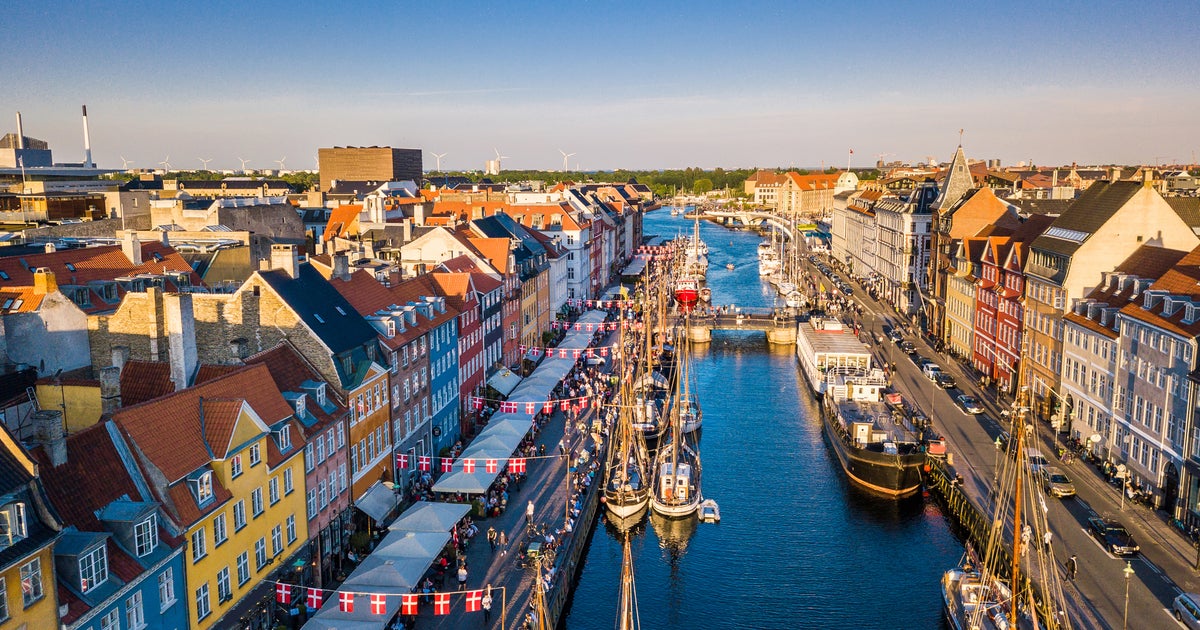 Copenhagen
8. Oslo, Norway
- Technological Infrastructure: Oslo has a highly advanced digital infrastructure with near-universal fiber optic broadband access and 5G coverage exceeding 90% of the city. The city’s smart lighting program has replaced over 80% of traditional streetlights with smart LEDs, resulting in energy savings of over 65% in those areas. Smart waste management utilizes sensors in underground waste containers, leading to a 15% reduction in collection trips. The environmental monitoring network includes over 400 sensors tracking air and water quality, with data publicly available in real-time. AI-powered traffic management systems have reduced congestion on key routes by an average of 12%. Public Wi-Fi is available at over 800 locations across the city.
- Sustainability Initiatives: Oslo is aiming for a 95% reduction in greenhouse gas emissions by 2030 (compared to 1990). Over 60% of the city’s energy consumption comes from renewable sources, primarily hydropower. The city has the highest penetration of electric vehicles globally, with over 35% of the total vehicle fleet being electric, supported by generous incentives. District heating is largely powered by waste incineration and biofuels, with ongoing investments in carbon capture technologies. Oslo maintains extensive green spaces, covering over 60% of the city area.
- Mobility Solutions: Oslo’s public transport system is efficient and increasingly electrified. The city aims for a fully electric public transport fleet by 2028, with significant investments in electric buses and ferries. The network of public EV charging points exceeds 2,500, with rapid expansion continuing. Oslo is investing heavily in cycling infrastructure, aiming for a 25% modal share for cycling by 2025. Smart parking solutions and real-time parking availability information help reduce traffic congestion in central areas.
- Citizen Engagement: Oslo has robust digital platforms for citizen engagement, with over 60% of residents using online portals for city services and information. Public consultations on urban development and environmental initiatives are actively conducted online. The city’s open data portal provides access to over 800 datasets. Initiatives like “Smart Oslo Accelerator” foster collaboration between startups and the city on innovative smart city solutions.
-
Key Statistics for Oslo:
- Fiber optic broadband access: Near 100%
- 5G network coverage: >90% of the city
- Energy savings from smart lighting (retrofitted areas): >65%
- Reduction in waste collection trips due to smart bins: 15%
- Percentage of energy consumption from renewable sources: >60% (primarily hydropower)
- Percentage of electric vehicles in the total fleet: >35%
- Target for a fully electric public transport fleet: 2028
- Number of public EV charging points: >2,500
- Target cycling modal share by 2025: 25%
- Percentage of residents using online city service portals: >60%
- Number of datasets on the open data portal: >800
- Target for greenhouse gas emission reduction by 2030 (compared to 1990): 95%
- Percentage of city area covered by green spaces: >60%
 Oslo
Oslo
9. Singapore
- Technological Infrastructure: Singapore’s “Smart Nation” initiative has resulted in a hyper-connected urban environment. Fiber broadband penetration is virtually 100%, and 5G coverage extends to over 98% of populated areas. The city-state has a dense network of over 20,000 IoT sensors, monitoring everything from air quality (with over 1,000 sensors) to pedestrian flow. The national digital identity system, Singpass, has over 4 million users, facilitating seamless access to over 1,600 digital services. AI is deeply integrated into urban planning, predictive maintenance of public housing (with AI analyzing data from over 1 million units), and public safety through an island-wide network of intelligent cameras.
- Sustainability Initiatives: Singapore is committed to its “Green Plan 2030,” with ambitious targets including quadrupling solar energy deployment to 2 GWp by 2030. Over 60% of buildings are targeted to be green-certified by 2030. The city-state is investing heavily in a circular economy, aiming to reduce landfill waste by 70% by 2035. Extensive vertical greenery and park connectors contribute to over 40% green cover across the island. Smart water management systems monitor consumption and leakage, achieving one of the lowest rates of non-revenue water globally (around 5%).
- Mobility Solutions: Singapore has a highly efficient public transportation system, with over 6 million daily passenger trips on its MRT and bus networks. The adoption of electric vehicles is strongly encouraged through incentives, with a target of all new car registrations being electric by 2030. The network of EV charging points is rapidly expanding, aiming for 60,000 by 2030. Autonomous vehicle trials are progressing, with pilot deployments in designated districts. Smart traffic management systems utilize real-time data and AI to optimize traffic flow, resulting in a reported 18% reduction in congestion on key expressways.
- Citizen Engagement: The “Our Singapore Fund” has supported over 1,000 citizen-led projects for community improvement. The “OneService” app handles over 50,000 municipal feedback reports monthly. Data.gov.sg provides access to over 10,000 government datasets, fostering transparency and innovation. Digital literacy programs reach over 100,000 citizens annually.
- Key Statistics for Singapore:
- Fiber broadband penetration: Near 100%
- 5G network coverage: >98% of populated areas
- Number of IoT sensors: >20,000
- Number of Singpass users: >4 million
- Target for solar energy deployment by 2030: 2 GWp
- Target for green-certified buildings by 2030: >60%
- Target for landfill waste reduction by 2035: 70%
- Green cover: >40% of the island
- Non-revenue water rate: ~5%
- Daily public transport ridership: >6 million
- Target for all new car registrations to be electric: 2030
- Target number of EV charging points by 2030: 60,000
- Reduction in congestion on key expressways due to smart traffic management: 18%
- Number of citizen-led projects supported by “Our Singapore Fund”: >1,000
- Monthly feedback reports on “OneService” app: >50,000
- Number of datasets on Data.gov.sg: >10,000
10. San Francisco, USA
- Technological Infrastructure: San Francisco benefits from its position as a global technology hub. High-speed broadband penetration is over 95%, and 5G deployment is rapidly expanding across the city. The city leverages IoT for various applications, including smart parking (reducing search times by an estimated 15% in pilot areas), smart waste management (optimizing collection routes), and environmental monitoring (with a growing network of air quality sensors). AI is being used in areas like traffic flow optimization, public safety analytics, and improving the efficiency of public transportation. Public Wi-Fi is available in numerous public spaces.
- Sustainability Initiatives: San Francisco has ambitious sustainability goals, aiming for net-zero greenhouse gas emissions by 2040. The city is promoting renewable energy adoption, with a goal of 100% renewable energy for city operations by 2030. Strict energy efficiency standards for buildings are in place. The city has a high waste diversion rate (over 80%), with ongoing efforts to further reduce landfill waste. San Francisco is also committed to expanding its urban green spaces.
- Mobility Solutions: San Francisco’s public transportation system, including Muni buses, streetcars, and BART, handles a significant number of daily commuters. The city is working to electrify its bus fleet and expand the network of EV charging stations (currently over 1,200 public points). Bike-sharing programs are popular, and the city is investing in improving cycling infrastructure. Smart traffic management systems are being implemented to alleviate congestion, particularly during peak hours. Autonomous vehicle technology is being actively tested in the city.
- Citizen Engagement: San Francisco has various digital platforms for citizen engagement, allowing residents to access city services, report issues, and participate in online consultations. The city has a robust open data program, providing access to a wide range of public information.
- Key Statistics for San Francisco:
- High-speed broadband penetration: >95%
- 5G network coverage: Rapidly expanding
- Reduction in parking search times due to smart parking (pilot areas): 15%
- Waste diversion rate: >80%
- Target for net-zero greenhouse gas emissions: 2040
- Target for 100% renewable energy for city operations: 2030
- Number of public EV charging points: >1,200
- Active testing of autonomous vehicle technology
- Robust open data program
 San Francisco
Comparative Snapshot of Leading Smart Cities in 2025
The following table offers a comparative look at key smart city indicators across the ten leading urban centers profiled in this analysis, providing a snapshot of their progress in technological integration and sustainable urban development.
| City | 5G Coverage | EV Charging | Renewable Energy | Bike Lanes | Public Transport | Open Datasets | Smart Streetlights | Recycling Rate | Congestion Reduction | Digital Engagement |
|---|---|---|---|---|---|---|---|---|---|---|
| London | >80% (100% by 2026) | >5,000 (10,000 by 2026) | Net-Zero by 2030 | >300 km | >11 million | >1,000 | Growing (full upgrade) | Target 40% by 2028 | 12% on smart lights, 15% projected | >300,000 “Talk London” users |
| New York | >95% (by 2025) | >3,500 (by 2025) | 70% ops by 2030 | N/A | >6 million | >7,500 | Growing | Growing | 7% avg, 6% pilot corridors | >10M NYC311 interactions |
| Paris | >90% (by 2026) | >5,000 (by 2027) | Net-Zero by 2050 | >600 km (1,000 by 2030) | >5 million | >3,000 | >100,000 (by 2027) | ~20% (35% by 2030) | 5% Metro wait (AI) | >2M monthly “Paris.fr” visits |
| Tokyo | ~100% | >2,000 | 50% by 2030, NZ by 2050 | N/A | >40 million | >2,000 | Growing | 45% (50% by 2028) | 10% reduction (smart mgmt) | Millions on govt portal |
| Berlin | >85% (by 2025) | >4,000 (by 2027) | 50% by 2030, NZ by 2045 | >1,000 km (2026) | >4 million | >4,000 | Growing | ~30% (40% by 2030) | 7% PT wait time (AI) | >500,000 mein.berlin.de users |
| Washington D.C. | >90% (by 2025) | >1,500 (by 2025) | 100% ops by 2032, NZ by 2050 | N/A | >2 million | >3,500 | >75,000 (by 2027) | 50% by 2030 (Target) | 8% key corridors (smart mgmt) | >1.5M DC311 requests |
| Copenhagen | >95% | >2,000 | 100% by 2025 | >400 km | High | >1,000 | Growing | High | 10% cyclist time (smart signals) | 70% use online portals |
| Oslo | >90% | >2,500 | 95% by 2030 | 25% modal share target | High | >800 | 80% LED upgraded | Growing | 12% key routes (AI) | 60% use online portals |
| Singapore | >98% | >4,000 (60,000 by 2030) | N/A | N/A | >6 million | >10,000 | Growing | 70% landfill reduction by 2035 | 18% expressways (smart mgmt) | >4M Singpass users |
| San Francisco | Rapidly Expanding | >1,200 | 100% ops by 2030, NZ by 2040 | Growing | High | High | Growing | >80% | 15% parking search time | High digital use |
Smart City Initiatives Across Spain’s Urban Centers
Beyond the globally recognized leaders, numerous Spanish cities are actively embracing smart technologies and strategies to enhance urban living, improve efficiency, and promote sustainability. This overview delves into the key smart city initiatives underway in ten prominent Spanish urban centers, highlighting their specific focus areas and ongoing developments.
Madrid:The Spanish capital is implementing a comprehensive smart city strategy centered on integrated urban management.Madrid is rolling out a smart city strategy focused on integrated urban management. A unified platform coordinates city services, improves traffic flow via real-time data and smart lights (cutting congestion by 10–15% on key routes), and boosts public transport efficiency with real-time systems. Sustainability efforts include smart grids for better energy use and retrofitting municipal buildings to cut energy consumption by 20% by 2028. Citizen engagement is promoted through service portals, feedback tools, and expanding open data initiatives.
If you want to learn more about Madrid leading the ranking of the smartest cities in Europe, click here
Barcelona: A pioneer in the smart city landscape, Barcelona continues to expand its IoT infrastructure, with over 20,000 connected devices managing aspects like smart parking (reducing search times by an estimated 15-20% in designated zones), intelligent waste bins that optimize collection routes, and smart lighting that adjusts based on pedestrian presence. Sustainability efforts include promoting renewable energy integration and expanding green corridors. Barcelona’s “CityOS” platform integrates data from various urban systems for enhanced decision-making. Citizen participation is strong through platforms like “Decidim Barcelona,” allowing residents to propose and vote on city projects.
If you want to learn more about how Barcelona is one of the top smart cities in Europe, click here
Valencia: Valencia is prioritizing sustainable mobility, with significant investments in its electric bus fleet (aiming for 50% electric buses by 2030) and a growing network of over 500 public EV charging points. The city’s bike-sharing service, Valenbisi, is being expanded and integrated with smart mobility apps. In terms of energy efficiency, Valencia is implementing smart building management systems in municipal buildings and promoting the use of solar energy. Digital platforms like the “Open Data Valencia” portal are enhancing transparency and citizen access to information.
Malaga: Malaga has established itself as a hub for smart tourism and energy innovation. The city has implemented a smart grid pilot project that has demonstrated a 10-12% reduction in energy losses. Smart lighting systems adapt to pedestrian and traffic flow, saving energy. Malaga is also using technology to enhance the tourist experience, with smart information kiosks and mobile apps providing real-time data. The city is actively promoting sustainable transportation options and investing in green infrastructure.
Seville: Seville is focusing on leveraging its rich cultural heritage with smart technologies. This includes smart management of tourist flows to reduce congestion in historical areas, intelligent public transport systems with real-time information, and energy-efficient lighting solutions for its monuments and public spaces. Seville is also developing digital platforms to provide personalized information and services to tourists and residents alike.
Bilbao: Bilbao’s smart city strategy emphasizes urban regeneration and sustainability. The city is implementing smart solutions for waste management, optimizing collection schedules based on fill levels. Energy efficiency in public buildings and street lighting is a priority. Bilbao is also investing in smart mobility, including electric buses and improved traffic management systems. Citizen engagement is fostered through online platforms for participation in urban planning initiatives.
A Coruña: A Coruña is developing a centralized smart city platform to integrate data from various municipal services, including transportation, energy, and waste management. The city is focusing on improving the efficiency of public lighting through smart controls and optimizing waste collection routes using sensor data. Digital tools are being implemented to enhance communication and interaction between citizens and the city council.
Palma de Mallorca: Palma de Mallorca is addressing the challenges of a major tourist destination through smart city technologies. This includes intelligent traffic management systems to alleviate congestion, smart solutions for water management to conserve resources, and energy efficiency measures in hotels and public infrastructure. The city is also focusing on sustainable waste management practices to protect its environment.
Zaragoza: Zaragoza is focusing on smart mobility and energy efficiency. The city has implemented real-time information systems for its public transport network and is investing in electric buses. Smart grid technologies are being explored for better energy management. Zaragoza also has initiatives to promote energy efficiency in residential buildings and enhance citizen access to digital services.
Murcia: Murcia’s smart city strategy prioritizes sustainable resource management and citizen engagement. The city is implementing smart water management systems to optimize irrigation and reduce water loss. Smart waste collection systems are being piloted to improve efficiency. Digital platforms are being developed to provide citizens with access to information and facilitate participation in local governance.
Spanish Smart City Landscape: A Comparative Glance
The following table offers a concise comparison of key smart city strategies and achievements across ten prominent urban centers in Spain, highlighting their distinct areas of focus and some of their measured impacts or future targets.
| City | Focus Area | Key Smart Initiative | Quantifiable Impact/Target |
|---|---|---|---|
| Madrid | Integrated Management & Mobility | Intelligent Traffic Lights | 12% congestion reduction (pilot) |
| Barcelona | IoT & Citizen Engagement | CityOS Platform | >22,000 connected devices |
| Valencia | Sustainable Mobility | Electric Bus Fleet | 50% electric by 2030 (target) |
| Malaga | Smart Tourism & Energy | Smart Grid Pilot | 10.5% energy loss reduction |
| Seville | Smart Tourism & Mobility | Intelligent Traffic Management | 10% commute time reduction (key routes) |
| Bilbao | Urban Regeneration & Waste | Pneumatic Waste Collection | 20% truck traffic reduction (pilot) |
| A Coruña | Integrated Platform & Efficiency | Smart City Platform | Integration of >1,000 sensors |
| Palma de Mallorca | Sustainable Tourism & Resources | Smart Water Management | 10% water reduction (pilot) |
| Zaragoza | Smart Mobility & Energy | Real-Time Public Transport Info | Serves >300,000 daily users |
| Murcia | Resource Management & Engagement | Smart Water Management (Agriculture) | 15% water usage reduction (pilot) |
Emerging Trends in Smart Cities: Shaping the Urban Future
The landscape of smart cities is constantly evolving, driven by rapid technological advancements and a growing understanding of urban challenges. Several key trends are poised to significantly shape the development and functionality of smart urban environments in the coming years:
-
Hyperconnectivity via 6G (Anticipated 2028-2030): Beyond current 5G (3.5B+ subscriptions by 2025), 6G promises Tbps speeds and ultra-low latency, supporting massive IoT deployments (potentially 10M devices/km²). This enables advanced applications like real-time holographic communication and sophisticated autonomous robotics (potential 25% maintenance cost reduction). Global 6G R&D investment is projected to exceed $7B annually by 2027.
-
Digital Twins ($8B market by 2030; 500+ cities by 2025): These virtual city replicas, updated with real-time data, are crucial for urban planning. They allow for simulating infrastructure impact (up to 90% traffic prediction accuracy), optimizing city-wide energy consumption (potential 10-15% reduction), and enhancing disaster preparedness (e.g., 15% planning approval time reduction in Singapore’s Virtual Singapore).
-
AI-Powered Autonomous Systems: Integrating AI into urban operations, this trend includes autonomous vehicles (projected 10M+ by 2030, with potential 90% accident reduction), autonomous delivery robots (handling up to 25% of last-mile deliveries), infrastructure inspection drones (potential 40% cost reduction), and intelligent energy grid management for optimized distribution.
-
Edge Computing ($25B market by 2030): Decentralizing computing power closer to data sources (billions of IoT devices) is vital for real-time applications. It enables faster response in smart traffic management (millisecond latency), public safety (95%+ anomaly detection in video), and autonomous vehicle navigation, also improving bandwidth efficiency and data security.
-
Citizen-Centric Metaverse & Smart Services: Future cities will offer personalized and immersive digital experiences. The metaverse (potential 10%+ virtual tourism by 2030) and AI-driven personalized services (potentially increasing citizen satisfaction with city services by up to 20% through tailored information on transport and energy) will enhance urban living.
-
Blockchain for Secure Governance ($5B market by 2028): This technology offers enhanced security and transparency for critical urban functions like digital identity management (potential 15% fraud reduction), transparent voting systems (potential 10% turnout increase), and secure transactions within smart energy grids and shared mobility platforms.
-
Focus on Resilience & Sustainability: Addressing climate change impacts drives the deployment of smart sensors and AI for early warning systems (potential 20% reduction in fatalities from extreme events), smart grids with microgrid capabilities, intelligent water management to conserve resources, and expanded green infrastructure to mitigate urban heat and improve stormwater management, aiming for ambitious carbon neutrality targets.
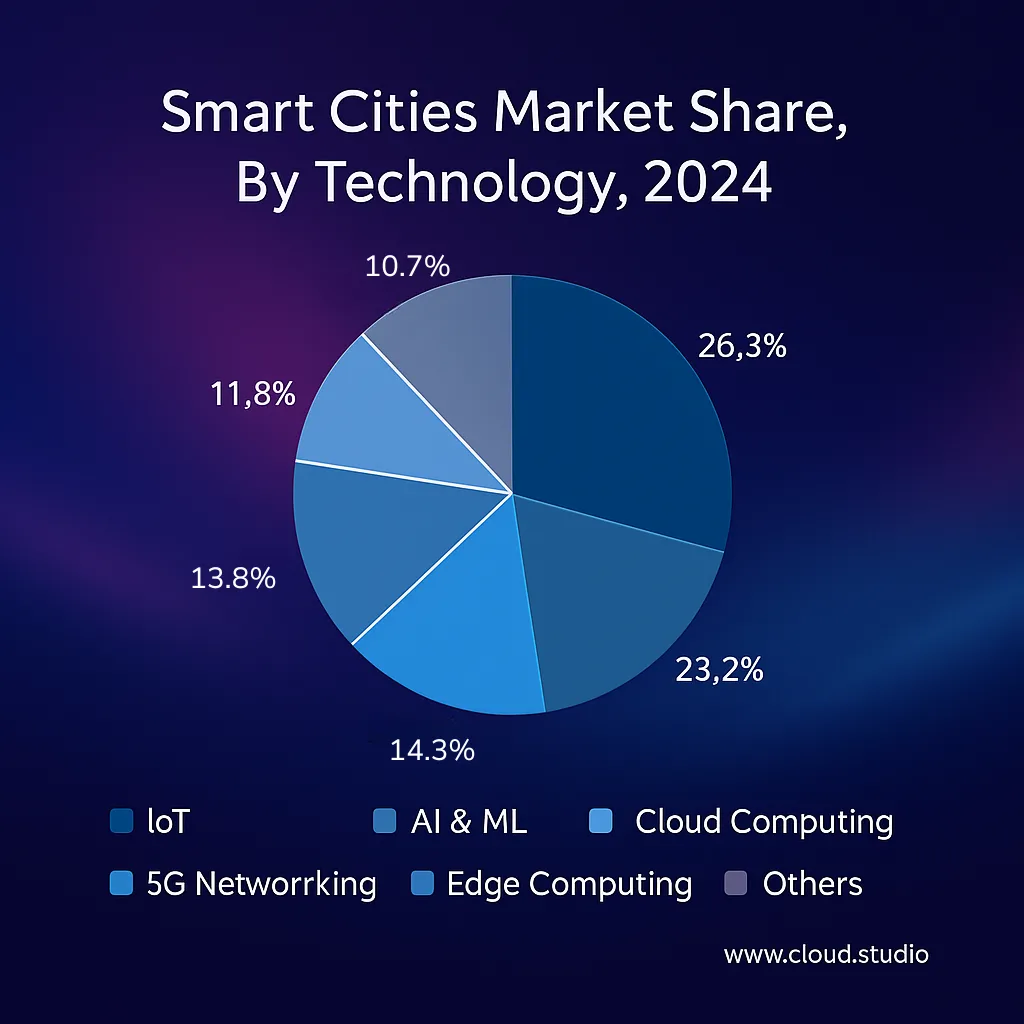 Smart cities market share by technology
Frequently Asked Questions
What is the global smart city market size and growth rate?As of 2024, the global smart city market is valued at approximately $550 billion USD. It is projected to grow at a compound annual growth rate (CAGR) of 20–25%, reaching $1.5 to $2 trillion USD by 2030.
What are the main factors driving smart city growth?Key drivers include increasing urbanization, rapid technological advancements (like 5G, IoT, AI), sustainability demands, rising expectations for public services, and proactive government initiatives and funding.
Why is urbanization important for smart city development?By 2050, nearly 70% of the world’s population will live in urban areas, according to the UN. Smart city technologies help manage population growth and relieve pressure on infrastructure and resources.
Which technologies are most important in smart cities?The most critical technologies include IoT, AI, cloud computing, big data analytics, and 5G. These enable real-time data collection, predictive management, and automation in city operations.
How do smart cities support sustainability?They promote energy efficiency, renewable energy integration, sustainable transportation, smart waste management, and reduced environmental impact through data-driven solutions.
What are some citizen benefits of smart city initiatives?Benefits include better public transport, safer streets, more responsive services, digital access to government, cleaner environments, and opportunities for civic participation through open data and digital portals.
Which smart city segments are leading the market?Leading segments include smart mobility ($150B), smart energy ($100B), smart governance and education ($80B), smart healthcare ($70B), and smart buildings ($60B) as of 2024.
Which regions dominate the smart city market?North America and Europe currently lead the smart city market in terms of adoption and investment. However, the Asia-Pacific region is expected to grow the fastest due to urbanization and government support.
What role do governments play in smart city development?Governments are central through funding programs, regulatory frameworks, and pilot projects. They also drive national sustainability goals and digital transformation through public-private partnerships.
How many connected devices are expected in smart cities?By 2030, smart cities are expected to host over 50 billion connected IoT devices, generating massive volumes of data to support intelligent decision-making across urban systems.
Related Articles

Symbio: Real-Time Water Safety with Clams and IoT
Symbio Project: Living Sensors for Clean Water In an extraordinary fusion of biology, environmental science, and IoT technology, the Symbio project, developed in Poland, introduces an innovative method for real-time monitoring of drinking water quality using freshwater mollusks, specifically from the species Unio tumidus. This biohybrid system is inspired by historical practices, like the use [...]

LoRaWAN in Spain: Industrial IoT Deployment Guide 2026
Considering Spain for your next LoRaWAN gateway procurement? While the European market offers robust options, navigating local distributors, manufacturers, and

Cloud Studio IoT vs. ThingsBoard Private Cloud: The Ultimate Benchmark
1. The Leap to a Private IoT Instance: A Necessary and Confusing Evil Your IoT project is taking off. The proof of concept was a success, the first clients are connected, and the volume of data is growing fast. It’s an exciting time, but one that demands critical decisions. Your current setup on a shared [...]
Ready to Transform Your Business?
Contact us to discover how Cloud Studio IoT can help you achieve your goals.